
In This Article
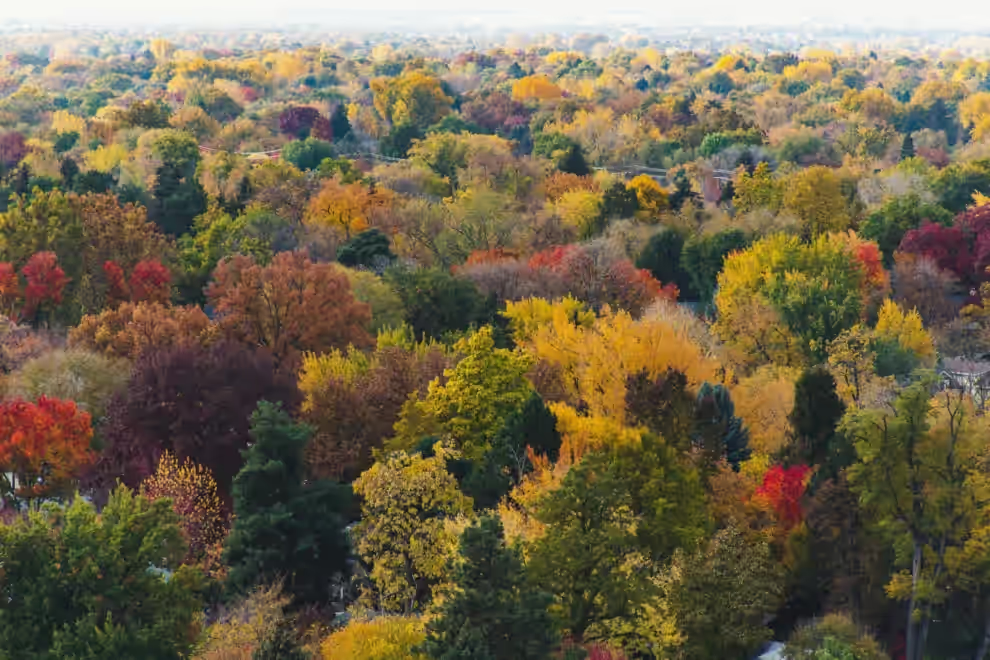
Every fall in the Treasure Valley, the cottonwoods along the Boise River turn gold, the maples in Nampa neighborhoods go red and orange, and the ash trees lining Eagle’s streets drop their leaves in waves. It’s one of the most beautiful seasonal transitions in southern Idaho — and it’s the visible result of a complex physiological process that trees have been perfecting for millions of years.
Understanding what’s actually happening inside your trees during this transition helps you make better decisions about fall care and gives you a deeper appreciation for why dormancy matters.
What Is Dormancy?
Dormancy is a state of reduced metabolic activity that allows trees to survive conditions — cold temperatures, reduced light, frozen soil water — that would otherwise kill their tissues. It’s not sleep in any meaningful sense. Dormant trees are still biologically active: roots are still absorbing water on warm days, stored carbohydrates are still being metabolized slowly, and defensive chemistry is still being produced.
Think of it less like sleep and more like a deliberate energy conservation mode — the tree has scaled back its most expensive activities (photosynthesis, growth, reproduction) and shifted its resources toward survival and preparation for spring.
How Trees Sense the Change in Season
Contrary to popular belief, the trigger for dormancy is not cold temperatures — it’s photoperiod, the length of daylight. Trees have light-sensitive proteins (phytochromes) that detect the shortening days beginning in late summer. This signal initiates the dormancy process weeks before temperatures drop.
This matters practically: a warm October does not delay dormancy significantly. The tree is already preparing regardless of what the thermometer says. Conversely, an unusually cold September doesn’t trigger early dormancy if day length hasn’t shortened enough.
This photoperiod sensitivity evolved to prevent trees from being fooled by temporary cold snaps in late summer and equally prevents them from breaking dormancy during a warm spell in February — when a return to freezing temperatures would be catastrophic.
The Physiological Process
Chlorophyll Breakdown and Fall Color
The brilliant fall colors we see in the Treasure Valley are a byproduct of chlorophyll breakdown, not new pigment production.
Chlorophyll — the green pigment responsible for photosynthesis — masks the other pigments present in leaves throughout summer. As days shorten, trees stop producing chlorophyll and the existing chlorophyll breaks down. This unmasks carotenoids (yellow and orange pigments) that were present all along.
The reds and purples are different. Anthocyanins are actively produced in autumn, particularly in maples, and their production is stimulated by bright sunny days combined with cool nights — exactly the conditions of a classic Treasure Valley October. This is why fall color intensity varies year to year depending on weather patterns.
Abscission Layer Formation
One of the most elegant adaptations in deciduous trees is the abscission zone — a specialized layer of cells that forms at the base of each leaf petiole. As dormancy preparation progresses, these cells differentiate and eventually form a clean separation zone that allows the leaf to detach without leaving an open wound.
Before abscission, the tree actively moves valuable nutrients — nitrogen, phosphorus, potassium — out of the leaf and back into the woody tissue, where they’ll be stored and available in spring. A leaf that falls in October is largely depleted of its mineral content. The tree has already reclaimed what it can.
Carbohydrate Storage
Throughout summer, trees produce more carbohydrates via photosynthesis than they use for immediate growth and maintenance. The excess is stored as starch in root tissue, trunk wood, and branches. In fall, this storage intensifies as photosynthesis slows and the tree concentrates on maximizing reserves.
These stored carbohydrates are what power spring bud break — the energy burst that pushes out new leaves before the tree has enough leaf area to be photosynthetically self-sufficient. A tree that entered the previous winter with depleted carbohydrate reserves will have a noticeably weaker spring flush.
What You Can Do to Help
Water deeply in October. Trees continue absorbing water until the ground freezes. A well-hydrated tree going into winter is more cold-hardy and enters spring with stronger root reserves. This is especially important in drought years.
Don’t fertilize with nitrogen in fall. Nitrogen stimulates new growth, which is the last thing you want in a tree preparing for dormancy. Fall fertilization can push late-season growth that doesn’t have time to harden off before frost, making it vulnerable to freeze damage.
Mulch the root zone. As discussed separately, mulch moderates soil temperature and retains moisture — two factors that directly support root health through winter.
Avoid pruning wounds in early fall. Fresh pruning cuts during early dormancy can bleed sap and may be more susceptible to certain fungal pathogens. Late winter (February–March in the Treasure Valley, just before bud break) is generally the best time for major structural pruning.
Treasure Valley Considerations
The Treasure Valley’s semi-arid climate creates some specific considerations. Our relatively dry falls mean that supplemental water is often more beneficial here than in wetter climates. The dramatic day-night temperature swings in October and November that produce spectacular fall color also mean that trees need to harden off quickly — there’s less of a gradual transition than in milder coastal climates.
Native and regionally adapted species (cottonwoods, box elders, native willows) are well-matched to these conditions. Exotic species — particularly those from warmer or wetter climates — may be more vulnerable to late-season freeze events and may benefit from extra attention in the fall.