In This Article
One of the most common structural defects in residential trees — and one of the most underestimated — is the codominant stem. This structural issue is responsible for a significant share of storm-related tree failures in the Treasure Valley, and yet it’s one that trained arborists can often address before a failure occurs.
What Are Codominant Stems?
A codominant stem condition occurs when a tree develops two or more upright stems of roughly equal diameter that compete for the dominant position in the crown. Instead of one clear leader with subordinate lateral branches, you get two (or more) competing stems growing upward from the same point of origin.
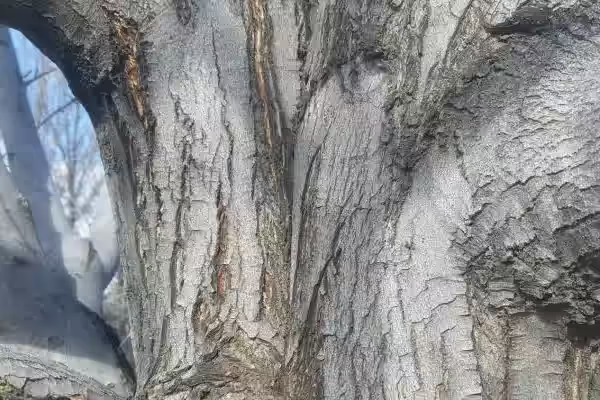
The critical problem isn’t the competition itself — it’s what happens at the attachment point. When two stems of similar diameter grow together, bark tissue becomes compressed and trapped between them as the stems grow. This included bark prevents the formation of a strong wood-to-wood bond. Instead of a solid structural connection, you have two stems pressed together with bark tissue in between — essentially a weak seam that the tree cannot reinforce.
Why Codominant Stems Are Risky
A well-attached lateral branch has a strong wood collar and connects to the main stem at an angle that distributes load effectively. A codominant stem with included bark has no such structural advantage.
Under stress — high winds, ice loading, saturated soil conditions after rain — the included bark zone acts as a natural splitting point. Failures at codominant unions are sudden and often catastrophic. A large stem can split away from the main trunk with no warning, taking a significant portion of the crown and exposing the interior of the tree to decay.
In the Treasure Valley, late spring windstorms are particularly dangerous for trees with codominant stems. The combination of a leafed-out crown (which catches enormous wind load) and saturated spring soils (which reduce root anchoring) puts maximum stress on structural weaknesses.
How to Identify Codominant Stems
You can identify codominant stems from the ground with a few visual cues:
- Two stems of roughly equal diameter growing from the same point
- A tight V-shaped crotch rather than a wider U-shaped union (wider unions are structurally stronger)
- A ridge of bark running up from the union — called a bark ridge — is a sign of a healthy attachment. A seam or crack at the union, or bark that appears to be squeezed between the stems, indicates included bark.
- Cracking or weathering at the union point in mature trees is a serious warning sign
Young trees are easier to evaluate — a handheld tool pushed into the union point will often reveal whether included bark is present.
Treatment Options
Structural Pruning (Young Trees)
The most effective intervention is the earliest one. In young trees (under 6–8 inches in trunk diameter), structural pruning can establish a clear dominant leader by selectively removing or subordinating competing stems. The goal is to create a crown architecture with one clear central leader and branches that are smaller than the leader in diameter.
This is why professional pruning of young trees isn’t just cosmetic — it’s an investment in structural integrity that pays dividends decades later. A tree that’s properly structured at age 5 rarely develops serious codominant stem problems.
Cabling and Bracing (Mature Trees)
When codominant stems are identified in mature trees that are otherwise healthy, supplemental support systems can significantly reduce failure risk without removing the stems. High-strength steel cables or synthetic flexible systems are installed between the competing stems, limiting the movement and separation that could lead to failure.
Cabling is not a permanent fix — it must be inspected and occasionally replaced — but it can extend the safe life of a valuable mature tree by decades. It’s particularly appropriate for trees in lower-risk locations that provide significant aesthetic or shade value.
Removal
When included bark is severe, the tree has significant decay at the union, or the location places the defect directly over high-value targets (homes, vehicles, play areas), removal may be the most responsible recommendation. An arborist’s job is to give you honest information about risk — not to tell you what you want to hear.
If a tree with a severe codominant stem failure point is positioned where a failure would cause significant damage or injury, the risk calculus changes substantially.
A Note on Risk Assessment
The presence of codominant stems doesn’t automatically mean a tree needs to come down. Risk depends on the severity of the included bark, the size and weight of the stems involved, the tree’s overall health, and the targets in the failure zone.
A TRAQ-certified arborist (Tree Risk Assessment Qualification) can conduct a formal assessment that quantifies the likelihood of failure and the consequence of failure, giving you documented information to make the right decision for your property.