In This Article
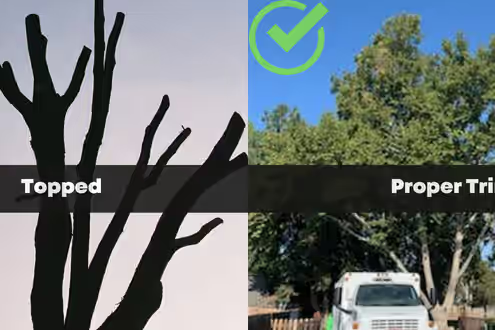
If you’ve lived in the Treasure Valley for any length of time, you’ve probably seen it — a tree that’s been cut flat across the top, with large stubs left where major branches used to be. This practice is called tree topping, and it’s one of the most harmful things that can be done to a tree.
Despite being widely practiced by unqualified crews, topping is condemned by the International Society of Arboriculture (ISA), the American Society of Consulting Arborists, and virtually every credentialed arboriculture organization. If a company is offering to “top” your tree, walk away.
Here’s why.
What Is Tree Topping?
Tree topping — also called “hat-racking,” “heading,” or “rounding over” — is the indiscriminate removal of large branches or the main trunk to stubs or lateral branches too small to assume the terminal role. The result is a tree with large open wounds, a grotesque silhouette, and a compromised physiological system.
It’s often sold as a way to reduce tree height, manage a “too-tall” tree, or make a tree “safer.” None of these claims hold up to scrutiny.
Why Tree Topping Is Harmful
It Causes Severe Stress
A mature tree may lose 50–100% of its leaf-bearing branches in a single topping event. Leaves are the tree’s food factory — they produce the carbohydrates that fuel growth, root development, and defense against disease and pests.
When a tree is topped, it enters survival mode. It rapidly pushes out epicormic shoots — weak, fast-growing sprouts from just below each cut — in a desperate attempt to restore its leaf area. This growth is energetically expensive and structurally inferior. It drains the tree’s stored energy reserves at the exact moment those reserves are most needed for recovery.
It Creates Decay and Disease Entry Points
Proper pruning cuts are made at branch collars — the swollen area where a branch meets a larger limb or trunk. These collar cells actively defend against decay. When cuts are made correctly, the tree can compartmentalize them and form a protective barrier.
Topping cuts are made arbitrarily through the middle of branches, leaving large stubs with no collar tissue. These stubs cannot close properly. Fungi and bacteria colonize the wound, decay moves inward, and in many cases the rot extends down into the main trunk — undermining structural integrity from the inside out.
It Makes Trees More Dangerous, Not Less
Topping is often justified as a safety measure. The reality is the opposite. The epicormic sprouts that emerge after topping are attached to the tree with only a layer of bark — they lack the structural wood-to-wood connection of natural branches. As these shoots grow longer and heavier over the following years, they become significantly more likely to fail than the original branches they replaced.
A tree that was topped five years ago and is now covered in vigorous new growth is often more dangerous than it was before the topping. The new branches are heavy, poorly attached, and full of decay from the original stub.
It Destroys the Tree’s Natural Form
Trees have been evolving their growth patterns for millions of years. Each species has a characteristic form that represents its optimal strategy for capturing light, managing wind load, and distributing structural stress. Topping obliterates this form permanently.
A topped tree never regains its natural shape. It becomes either a grotesque stub-and-sprout structure or it dies prematurely — often within 10–15 years of being topped. Either way, the property owner ends up paying for removal of a tree that was a valuable asset before it was topped.
What to Do Instead
If your concern is height or size, crown reduction is the appropriate alternative. Unlike topping, crown reduction:
- Removes branches back to lateral branches large enough to assume the terminal role
- Maintains the tree’s natural shape and taper
- Makes cuts at proper collar points, allowing the tree to close wounds effectively
- Reduces height by 20–30% without the catastrophic consequences of topping
If your concern is deadwood, hazardous branches, or density, crown cleaning and thinning address those issues without removing healthy live wood from the top.
If a tree has genuinely outgrown its location and cannot be safely managed through crown reduction, removal may be the honest recommendation — a much better outcome than topping the tree and leaving the owner with a damaged, dangerous, declining tree for a decade.
An ISA-certified arborist can assess your specific tree and recommend the right approach. Don’t let price be the deciding factor — a cheap topping job often leads to expensive removal within a few years.